Bathroom floors · · 7 min read
Tile or Vinyl Plank for a Bathroom Floor? A Zone-by-Zone Guide
Most people planning a new bathroom floor are choosing between porcelain tile and luxury vinyl plank, with marble or travertine as the dream option. The useful answer depends on which part of the floor you mean, because a shower floor, the strip around a toilet and the open floor by the vanity meet water in very different ways.
The Short Answer
If water will stand on it, tile it. A shower floor is part of the waterproofing: it sits on a pan or a waterproofed base that slopes to the drain, and porcelain or stone tile is the surface you stand on. Vinyl plank is not made for that job.
Everywhere else in the room, water arrives as splashes over the tub edge, drips from a towel or the occasional overflow. Porcelain tile and waterproof vinyl plank can both cope with that when they are installed for a bathroom. That is where the real decision sits, and it turns on comfort underfoot, upkeep, budget and how the floor meets the hallway.
One room, three conditions
Three Parts of the Same Floor
Inside the shower
Tile on a sloped, waterproofed base
Small tiles follow the slope toward the drain, and their extra grout joints give wet feet more edges to grip. Large panels belong on the walls; the floor wants a mosaic or a small format.
Around the tub and toilet
Where the edges decide it
Water that gets past the surface goes in at the edges: the toilet flange, the tub apron, the shower curb. With plank, those edges get sealed. With tile, the grout and the bed it sits in carry the load.
The open floor
A genuine choice
By the vanity and the door, the floor mostly sees bare feet and the odd splash. Warmth, cost, cleaning and a clean line into the hallway are what tip it one way or the other.
What “Waterproof” Means on a Box of Vinyl Plank
Rigid-core vinyl plank, often sold as SPC, does not swell when it gets wet, and that is why it moved into bathrooms. But the word describes the plank, not the floor. A floating plank floor still has seams between boards and a gap around the edge of the room so it can expand. Water that finds those openings ends up underneath, on the subfloor, where nobody sees it.
That is why manufacturers spell out the bathroom details. MSI's guide to luxury vinyl in a bathroom says every vinyl edge exposed to the toilet flange or the shower edge must be sealed with silicone caulk, to keep water from building up under the floor. Gap sizes and approved sealants vary by brand, so the installation sheet for the exact plank you pick is the one that counts.
Done that way, plank earns its place. It is warmer and softer underfoot than tile, it goes down faster, and a damaged plank can often be replaced on its own instead of chiseling out a tile and regrouting around it.
Porcelain Tile: Two Numbers Worth Checking
Porcelain and ceramic look alike on a showroom board. The difference is density. Writing for ASTM, the Tile Council of North America explains that only tile with water absorption of 0.5% or less, tested under ASTM C373, can be certified as porcelain by the Porcelain Tile Certification Agency. That low absorption is what lets porcelain live in a wet room without soaking anything up.
The second number is slip resistance, listed on spec sheets as DCOF. Crossville, a U.S. tile maker, describes a wet DCOF of 0.42 or greater as the industry standard for tile on level interior floors that are walked on when wet, and adds that the figure alone does not make a tile right for every project. A polished tile and a matte one can look identical in the box and feel very different under wet feet, so read the sheet before you fall for a sample.
Two things to plan for with a tile floor: it is cold first thing in the morning, and a cracked tile is a careful repair rather than a quick swap. Keep a few spare tiles from the same batch in the garage.
Marble and Travertine: Beautiful, With House Rules
Natural stone gives a bathroom something a printed tile cannot copy: no two pieces are the same. Marble and travertine are also calcium-based, and that changes what goes in the cleaning cupboard. The Natural Stone Institute warns that products containing lemon, vinegar or other acids may dull or etch this kind of stone, and recommends a neutral cleaner, stone soap or mild dish soap in warm water. It also notes that some rust removers and toilet bowl cleaners contain hydrofluoric acid, which attacks every stone, granite and quartzite included. Sealing helps, but in the Institute's words it makes stone more stain resistant, not stain proof.
So a stone bathroom floor comes with a short set of house rules: a stone-safe cleaner under the sink, care with toilet bowl cleaner near the base, and a bath mat with a slip-resistant back. If that sounds like more than you want to keep up, a marble-look porcelain gives most of the look without the etching.
Two Materials, One Bathroom
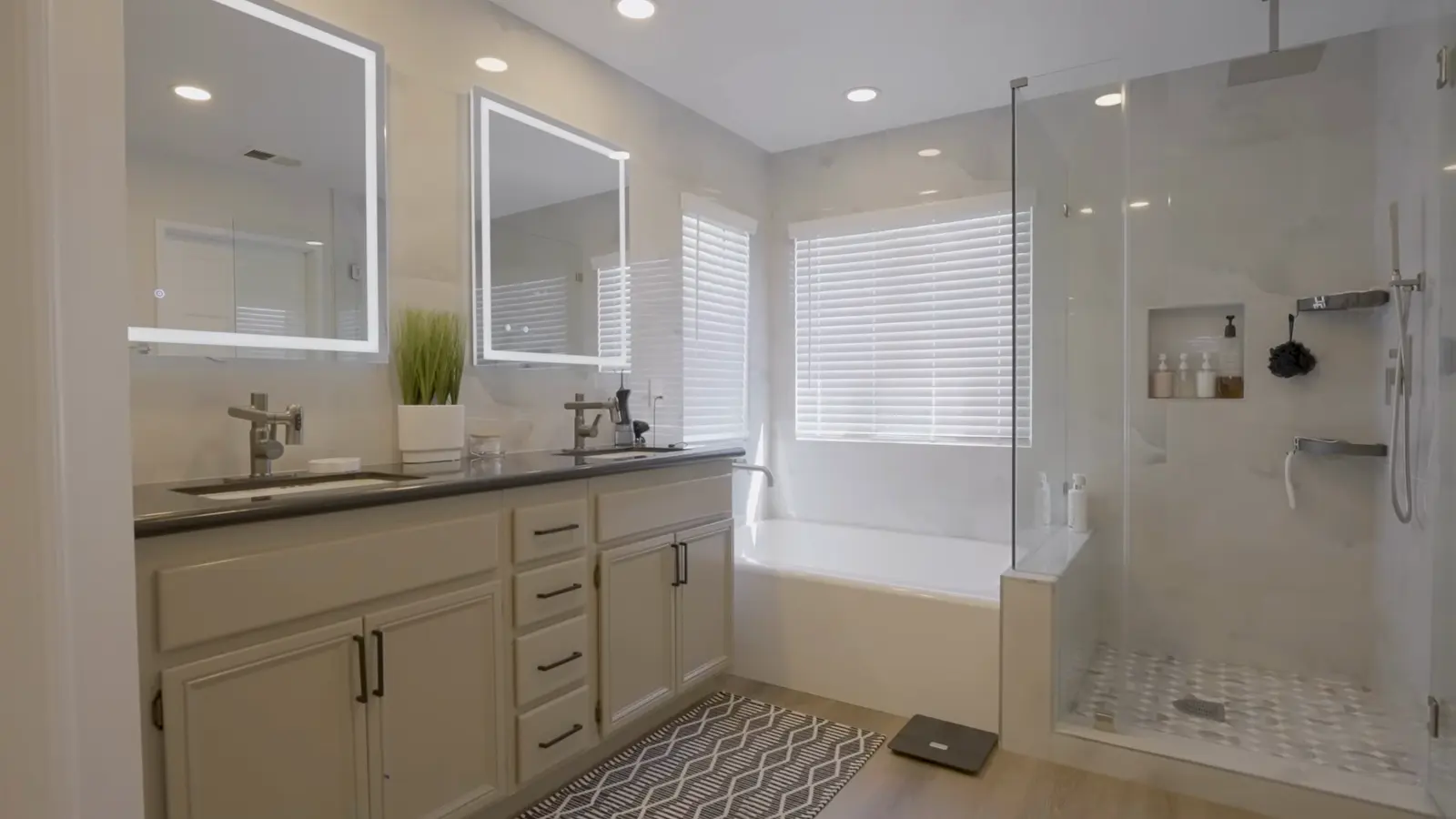
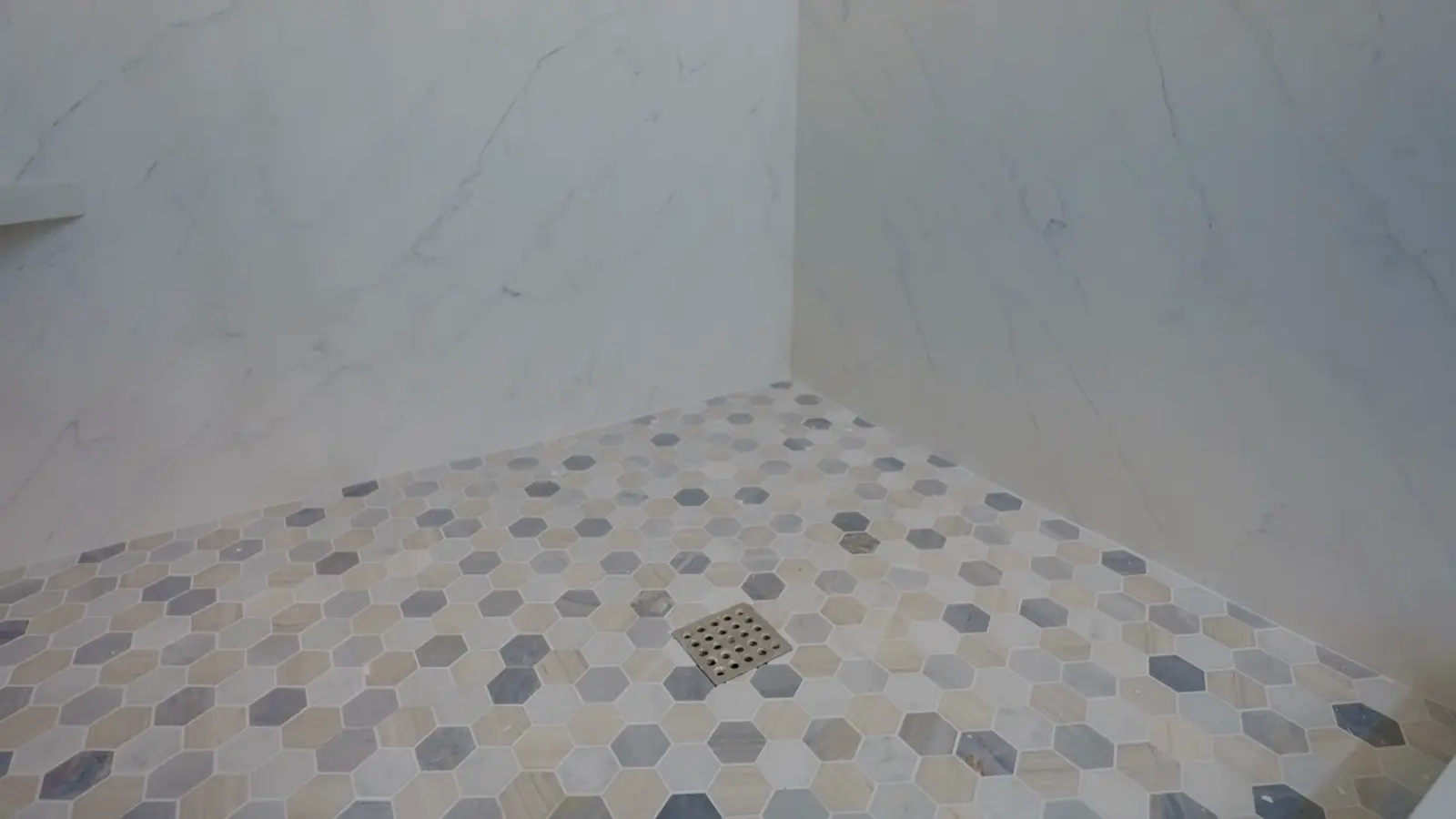
You do not have to pick one material for the whole room. In Chris's primary bathroom, pictured at the top of this page, a wood-look floor runs through the room while the shower behind the frameless glass has a small mosaic floor. In the Laguna Niguel shower shown here, a multi-tone hexagon mosaic covers the floor under large marble-look wall panels.
Splitting it this way lets each material do what it is built for: tile where water collects, and plank or larger tile where people stand to brush their teeth. Plan the doorway as well. If the bathroom floor differs from the hallway in material or height, the two need a transition at the threshold, and it is easier to choose that strip before the floor goes in than after.
Matching the Floor to the Bathroom
A kids' or hall bathroom
Water over the tub edge is a daily event. Porcelain takes it without fuss. Plank works too, as long as every edge at the tub and toilet is sealed and the bath mat stays where it belongs.
A primary bathroom
Here the look and the feel underfoot matter most. Large-format porcelain or stone makes the floor feel like part of the shower walls; plank makes the bathroom feel like a continuation of the bedroom next to it.
A rental or a unit you plan to sell
Speed of installation and easy repairs usually come first, which favors plank. Choose a mid-tone that hides water spots and scuffs between tenants.
A powder room
No shower, no tub and very little water. Any of the three works, so decide on looks and on how the floor meets the hallway outside the door.
How We Approach It
Our bathroom remodel package lists a luxury vinyl plank floor with new baseboards, alongside a new shower pan or tub and tile or quartz shower walls. If you would rather have porcelain tile or natural stone underfoot, say so at the consultation. We install both, and you get the price for the room in writing before any work starts.
Bathroom floor questions
Frequently Asked Questions
Choosing between two samples? Call Nicholas at 858-271-4565.
Can vinyl plank go inside a shower?
No. A shower floor has to carry water to the drain over a sloped, waterproofed base, which is the job of a shower pan or of tile set on a waterproofed base. Vinyl plank belongs on the floor outside the shower.
Is porcelain tile the same as ceramic tile?
Porcelain is a denser kind of ceramic tile: to be certified as porcelain it must absorb 0.5% of its weight in water or less under ASTM C373. That density is why it is the stronger pick for a floor that gets wet.
Does a vinyl plank bathroom floor need sealing?
The planks themselves do not. The edges do: where the floor meets the toilet flange, the tub and the shower, manufacturers call for silicone so water cannot run underneath. Follow the instructions for your specific plank.
Is a marble bathroom floor a bad idea?
Not if you are happy with the care it needs. Acidic cleaners, vinegar and some toilet bowl cleaners can etch or damage it, so it calls for a neutral, stone-safe cleaner. If you want the look with less upkeep, consider a marble-look porcelain.
Will a tile bathroom floor be slippery?
It depends on the tile, not on tile in general. Look for a wet DCOF of 0.42 or higher on the spec sheet for a level bathroom floor, use small mosaics in the shower, and put a mat with a slip-resistant back outside the tub or shower.
Sources
- Tile Council of North America, “Standards and the Ceramic Tile Industry,” ASTM Standardization News: porcelain defined by water absorption of 0.5% or less under ASTM C373.
- Crossville, “Porcelain Tile DCOF Ratings and Applications”: wet DCOF of 0.42 or greater for level interior floors walked on when wet.
- Natural Stone Institute, “Stone Care”: acids and calcium-based stone, hydrofluoric acid in some cleaners, what sealing does.
- MSI, “Installing Luxury Vinyl Flooring in the Bathroom”: sealing vinyl edges at the toilet flange and shower.